
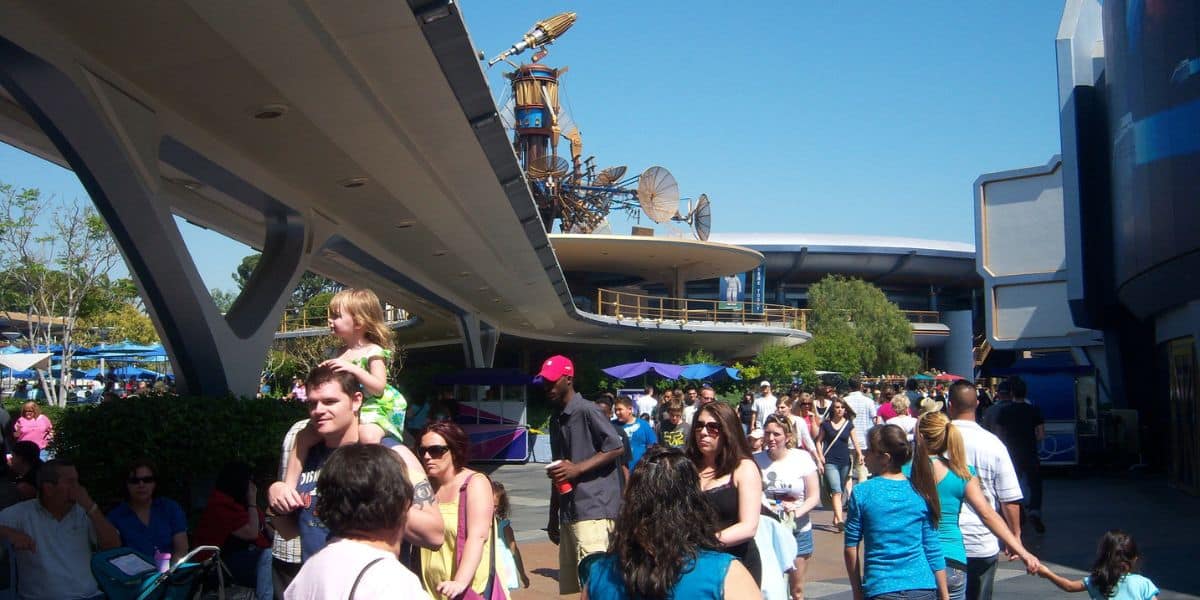
For nearly thirty years, the former PeopleMover tracks have snaked their way through the skyline of Disneyland's Tomorrowland — a silent, concrete monument to a bygone era, serving as a daily reminder of the kinetic energy that once pulsed overhead. Now, a recent discovery along those very tracks has reignited decades of debate, rumors, and desperate hopes among the Disneyland fandom.
The Mystery of the Tomorrowland Tarps
The latest round of speculation erupted when guests riding the Disneyland Monorail spotted something highly unusual along the elevated PeopleMover highway: a massive, clear plastic drop sheet suddenly covering a significant portion of the abandoned tracks. The tarp extends from a covered portion of the track structure directly out into the open air and is firmly secured in place by several heavy sandbags.
When a popular theme park creator shared a photo of the covered tracks on X (formerly Twitter), the post quickly drew attention from Disneyland fans, who immediately began debating what the tarp's presence could mean. Some speculated that the plastic sheeting was the first step in a demolition process — a sign that Disney was finally preparing to remove the decaying infrastructure. Others held out hope that the tracks were being evaluated for a future attraction.
The most grounded theory, however, came from the comments section of the post. Several users pointed out that a plastic drop sheet can serve as a temporary measure to divert water, possibly from a leak. Because the PeopleMover tracks run directly above several pedestrian walkways and attraction queues, a leak in the aging concrete structure could pose a nuisance to guests below. Some observers suspect a leak is the culprit while maintenance crews assess the damage.
As of September 17, 2026, Disney has not officially commented on the reason behind the tarps, leaving the door wide open for fan speculation.
The Rise and Fall of the Disneyland PeopleMover
To understand why a simple piece of plastic can cause such an uproar, you have to appreciate the deep emotional connection Disneyland fans have with the PeopleMover. The attraction, presented by Goodyear when it opened, debuted to the public on July 2, 1967, as an integral part of Walt Disney's "New Tomorrowland" — a massive expansion that brought a sleek, mid-century modern vision of the future to life.
Guests boarded small, colorful, open-air trains propelled continuously along an elevated highway by a series of rotating tires embedded in the track. The PeopleMover was never designed to be a thrill ride. Instead, it offered a relaxing, breezy, 16-minute grand circle tour above Tomorrowland, weaving in and out of attraction buildings — including passing directly through the massive show building for Adventure Thru Inner Space (and later, Star Tours) and offering a spectacular overhead view of the Star Cade.
But it was more than just a ride. It was a working prototype of Walt Disney's vision for urban mass transit. He genuinely believed that this continuous-motion system could be a solution to urban congestion and suburban commuting.
Disneyland permanently closed the PeopleMover on August 21, 1995, amid broader plans to revise Tomorrowland. Public accounts have cited a mix of financial, operational, and creative factors for its closure.
The Rocket Rods Disaster
The tracks didn't stay empty for long — but their second life was notoriously short-lived. In 1998, Disney debuted a massive Tomorrowland overhaul that included a brand-new attraction utilizing the PeopleMover infrastructure: the Rocket Rods.
Billed as a high-speed thrill ride, the Rocket Rods sent guests zooming along the elevated tracks in dragster-style vehicles. However, the project was fundamentally flawed from the start. Because Disney opted not to bank the original curves of the PeopleMover track to accommodate higher speeds, the Rocket Rods were forced to accelerate aggressively on straightaways and slow substantially before tight turns. That stop-and-go operating profile contributed to substantial reliability problems and repeated downtime.
The ride was a logistical nightmare and was permanently closed in 2000, roughly two and a half years after it opened. The former PeopleMover/Rocket Rods track has sat unused ever since.
The Desperate Cry for a Return
The abandonment of the tracks has been a sore spot for Disneyland loyalists for a quarter of a century. The concrete highway takes up a massive footprint in Tomorrowland, serving as a constant visual reminder of what was lost. The frustration is compounded by the fact that a version of the attraction — the Tomorrowland Transit Authority PeopleMover — still operates daily at Magic Kingdom in Walt Disney World. East Coast fans still get to enjoy the relaxing, elevated tour, while West Coast fans are left looking up at empty concrete.
Calls for the PeopleMover's return have become a recurring theme among Disneyland fans. Every time a new rumor surfaces about Tomorrowland, the first question fans ask is, "Are they bringing back the PeopleMover?"
There is a glimmer of hope on the horizon. At D23 2026, Disney executives officially confirmed that a reimagining of Disneyland's Tomorrowland is in development. While no detailed formal plans or concept art have been released, the announcement has fans dreaming big.
Will the planned Tomorrowland reimagining finally see the complete demolition and removal of the track structure? Or, against all odds, will the Imagineers find a way to retrofit the highway and bring the PeopleMover back to its former glory? For now, all we have are tarps, sandbags, and thirty years of hope. Whatever happens next, the Disneyland fandom will be watching the skies of Tomorrowland very closely.