
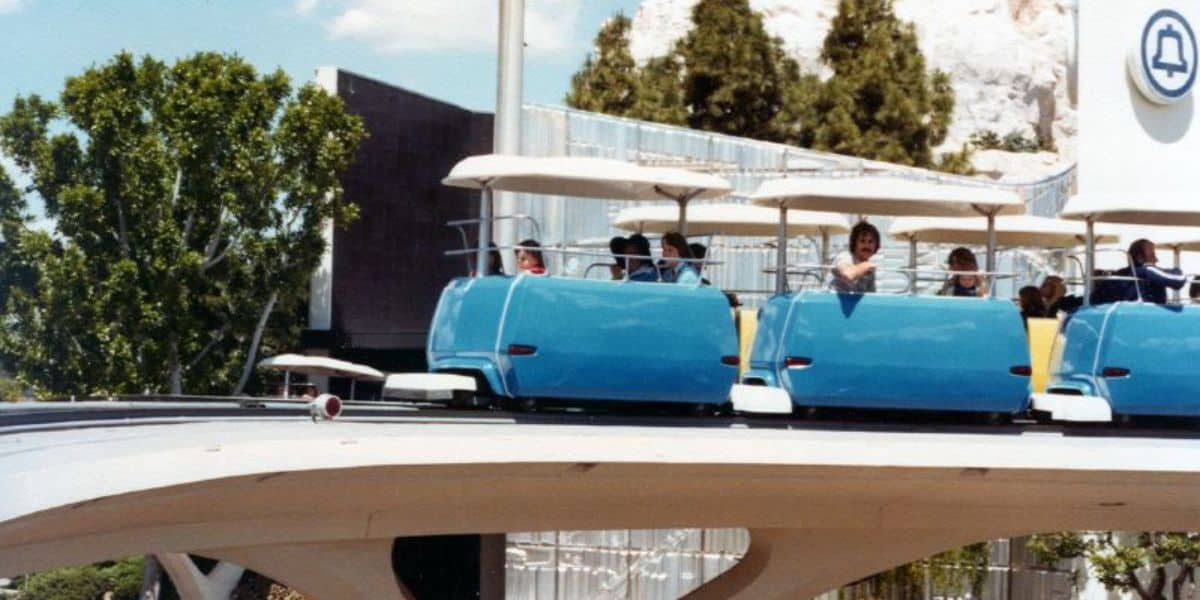
Ask any devoted Disney fan to name the most heartbreaking losses in theme park history, and Disneyland's PeopleMover will almost certainly land near the top of the list. For nearly three decades, that gentle elevated highway offered guests a beloved bird's-eye tour of Tomorrowland before closing its gates in 1995. Today, Magic Kingdom guests can still enjoy the smooth glide of the Tomorrowland Transit Authority PeopleMover at Walt Disney World — and most fans assume that's the only operating Disney-designed WEDway PeopleMover still out there.
They would be wrong.
Hidden beneath the subterranean concourses of George Bush Intercontinental Airport (IAH) in Houston, Texas, sits a fully operational, Disney-designed transit system. Officially known as the Subway, this underground train was developed using technology from WED Enterprises — the original name for Walt Disney Imagineering. While Disneyland's track now sits as a silent ghost highway weaving through Anaheim's Tomorrowland, Disney's airport subway in Texas has been transporting millions of air travelers every year for more than four decades.
The Secret Origin of Disney's Airport Subway
To understand how Disney technology ended up beneath a Texas airport, you have to look back at Walt Disney's grandest vision: EPCOT.
When Walt Disney purchased thousands of acres of central Florida swamp in the mid-1960s, he didn't intend to simply build a bigger Magic Kingdom. His original dream was the Experimental Prototype Community of Tomorrow — a futuristic, functioning city where 20,000 residents would live, work, and commute without the noise, pollution, and traffic jams of private automobiles.
The key to Walt's traffic-free utopia was public transportation. Electric monorails would handle long-distance commutes between the city center and outer hubs, while a continuous, silent system — the WEDway PeopleMover — would move people through the urban core.
When WED Enterprises developed the PeopleMover for Disneyland's 1967 Tomorrowland overhaul, it wasn't just a theme park attraction. It was a practical demonstration of an automated transportation concept that Disney believed could have real-world applications far beyond amusement parks.
Houston Intercontinental Airport opened in 1969, and as the airport's transportation needs evolved, officials eventually sought a new automated inter-terminal system. Through a competitive process in 1979, Houston selected Disney's WEDway technology. Impressed by Disney's innovative transit approach, the Houston Airport System contracted with WEDway to develop a new underground PeopleMover system.
How Disney Built a Subway: Linear Induction and Passive Cars
When WEDway was selected for Houston, designers used a transportation system built on the same basic principles that had made Disney's PeopleMover concept distinctive.
Disneyland's 1967 PeopleMover used electric-motor-driven rubber wheels embedded directly into the track to propel passive, motorless cars forward. Later WEDway systems — including Houston's — used Linear Induction Motors (LIMs) to propel lightweight vehicles along the guideway. Here's how the technology worked:
- Passive Vehicles: The subway cars had no onboard propulsion system — they were lightweight vehicles designed to be moved entirely by the track-based system.
- Track-Based Propulsion: Linear induction motors along the guideway generated electromagnetic forces that propelled the vehicles through the tunnel.
- Continuous Flow: Because the propulsion system was integrated into the guideway, vehicles could move smoothly around a continuous loop with relatively little mechanical complexity in the cars themselves.
The Houston WEDway Subway officially opened on August 17, 1981. The system used an underground loop to connect the airport's terminals and hotel, providing an automated way to move travelers and airport users around the growing complex. It's worth noting that Magic Kingdom's WEDway PeopleMover had already opened in 1975, making Houston's system a later application of Disney's transportation technology rather than the source of what eventually came to Walt Disney World.
Disneyland vs. Houston: A Tale of Two PeopleMovers
It's one of the great paradoxes of Disney history: why did Disneyland's PeopleMover close forever while Houston's Disney subway kept right on rolling?
The end of Disneyland's PeopleMover came when Disney pursued a high-speed attraction for the 1998