
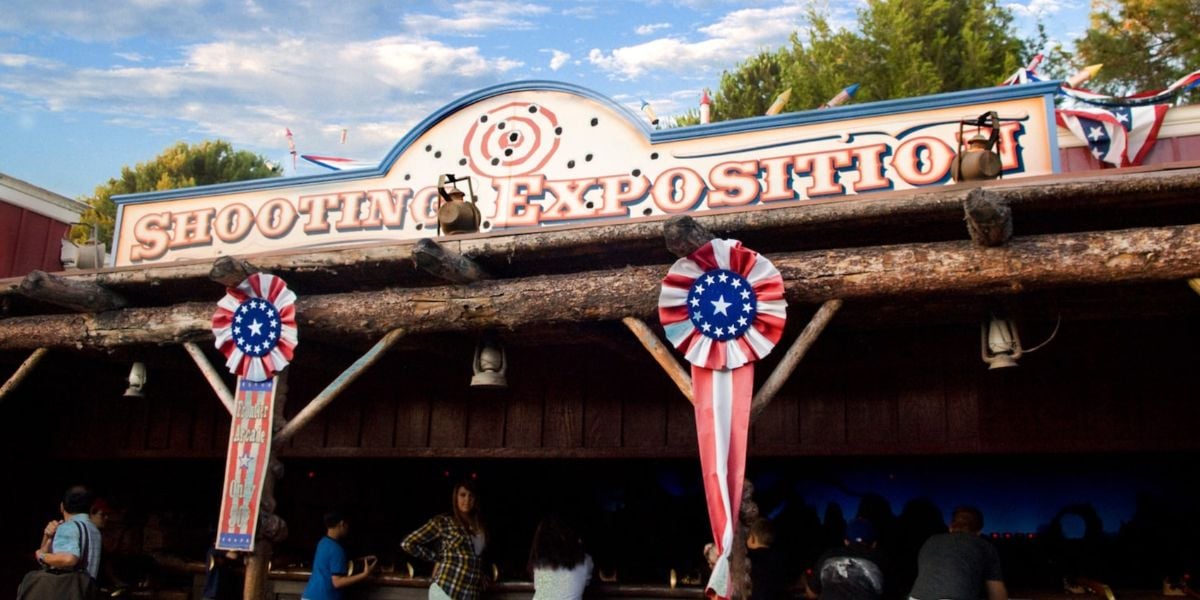
On September 11, 2026, Disneyland Park welcomed guests back to the Frontierland Shootin' Exposition after a roughly two-month refurbishment — a warm, nostalgic moment that stands in sharp contrast to what's happening across the country at Walt Disney World's Magic Kingdom, where heavy machinery and construction walls mark the teardown of key Frontierland landmarks.
The two parks are telling very different stories about how Disney's iconic themed lands can evolve. While Anaheim continues to preserve and refresh classic interactive experiences, Orlando is undertaking a major thematic overhaul that introduces high-profile movie franchises into areas long associated with mid-century Americana.
Disneyland's Refreshed Frontierland Shootin' Exposition
The Frontierland Shootin' Exposition temporarily closed for maintenance on July 6, 2026, disappearing behind themed scrims and wooden scaffolding for the height of the summer season. When the construction walls finally came down on September 11, guests discovered a refreshed rustic log cabin complete with new paint and updated exterior details.
Set in the dusty 19th-century frontier town of Tombstone, Arizona, the interactive shooting gallery challenges marksmen of all ages to test their skills against a spooky Boot Hill cemetery backdrop populated by nearly 100 interactive targets. Rather than firing physical lead pellets, guests shoulder a replica .54-caliber Hawkins buffalo rifle and aim safe, invisible infrared beams at hidden sensors across the gallery. Striking a target triggers immediate kinetic reactions — spinning tombstone props, eerie sound effects, and mechanical skeletons popping out of wooden crates.
Operating on a credit-based system where one credit yields approximately 25 shots, the attraction remains a tactile, walk-up experience that encourages friendly competition among families. Disneyland's decision to preserve and polish the Shootin' Exposition reflects a broader commitment to maintaining the unique architectural texture and kinetic energy of its original 1955 park layout.
The Magic Kingdom Contrast: Demolition and Overhaul in Orlando
While Disneyland guests are once again testing their marksmanship in a lovingly refreshed Western setting, Walt Disney World has taken a radically different approach to its own version of Frontierland.
The divergence began in June 2024, when Magic Kingdom permanently closed its Frontierland Shootin' Arcade. Rather than refurbishing the interactive gallery, Disney cleared out the historic interior space to construct a private Disney Vacation Club (DVC) member lounge. The loss of the arcade removed a low-cost, family-friendly walk-up experience that had anchored the land since opening day in October 1971.
But the closure of the shooting arcade was merely the prologue to a far more extensive reimagining of Magic Kingdom's western footprint:
- Removal of Rivers of America & Tom Sawyer Island: Disney announced the permanent closure and removal of Tom Sawyer Island and the surrounding Rivers of America to make way for a massive new Cars-themed expansion. The historic Liberty Belle Riverboat will be retired, and the former Rivers of America basin has been drained and cleared. Disney's plans call for the new Piston Peak National Park to include rivers, waterfalls, mountains, and other wilderness features.
- The Arrival of Piston Peak & Pixar: The new Cars area introduces two original attractions themed around off-road rally racing through the rugged wilderness of Piston Peak, trading traditional American frontier lore for the Disney and Pixar Cars universe. The attractions are Cars Ridge Run Rally and Miss Fritter's Daredevil Spin-Along.
- Villains Land Expansion: Beyond the Cars footprint, Disney is developing an unprecedented Villains-themed land situated beyond Big Thunder Mountain Railroad, further shifting the narrative focus of Magic Kingdom's western quadrant toward dark fantasy and character-driven entertainment. Disney has announced two major attractions for the land, including a Maleficent-themed coaster and a dark ride set within the Mirror Realm.
While these major additions promise cutting-edge ride technology and additional guest capacity, they come at the direct expense of the quiet, opening-day atmosphere that defined Magic Kingdom's original Frontierland for over five decades.
Why the Two Parks Are Moving in Opposite Directions
Theme park historians and Disney enthusiasts often note that Disneyland and Walt Disney World operate under distinctly different spatial, operational, and cultural constraints — and those differences go a long way toward explaining their divergent approaches.
Spatial Realities and Master Planning
Disneyland Park operates within a tightly constrained 85-acre footprint surrounded by public streets in Anaheim. Because space is at a premium, Imagineers cannot easily make sweeping changes to major existing features without affecting neighboring lands and infrastructure. As a result, Disneyland frequently relies on careful preservation, incremental upgrades, and smart use of space.
Walt Disney World, by contrast, encompasses more than 27,000 acres in Central Florida. With vastly more land available for development, Disney has far greater flexibility to undertake large-scale expansion projects — and that flexibility has been particularly evident at Magic Kingdom, where Disney is pursuing multiple major projects simultaneously, adding new attractions and capacity while bringing additional Disney and Pixar intellectual property into the park.
Intellectual Property vs. Historic Nostalgia
Disneyland remains deeply connected to Walt Disney's personal legacy. Attractions like the Frontierland Shootin' Exposition, the Mark Twain Riverboat, and Pirate's Lair on Tom Sawyer Island represent direct ties to the founder's vision of mid-century storytelling and historical Americana.
At Magic Kingdom, recent development plans place greater emphasis on integrating corporate intellectual property. By replacing historical frontier motifs with characters from Pixar's Cars and classic Disney animated villains, Disney is introducing contemporary franchise-based storytelling into a section of the park that Western and frontier themes have historically dominated. The shift can reasonably be viewed as part of Disney's broader effort to balance historical park identity with newer intellectual properties, though the company's specific motivations for each project have not been publicly established.
What Lies Ahead for Disney's Frontierlands
For Disneyland visitors, the reopening of the Frontierland Shootin' Exposition is a heartwarming victory for preservationists — a demonstration that small-scale, kinetic, tactile experiences still have a place in modern theme parks alongside high-budget thrill rides and immersive dark rides.
For Walt Disney World fans, the coming years will bring dramatic physical changes as construction transforms the former Rivers of America site into the wilderness setting of Piston Peak National Park and as Villains Land takes shape beyond Big Thunder Mountain.
While both resorts continue to evolve to meet changing guest expectations, September 11, 2026, serves as a vivid reminder of their divergent paths: in Florida, Frontierland's past is being cleared and reimagined for the future, while in California, the spirit of the Old West is getting a fresh coat of paint.